
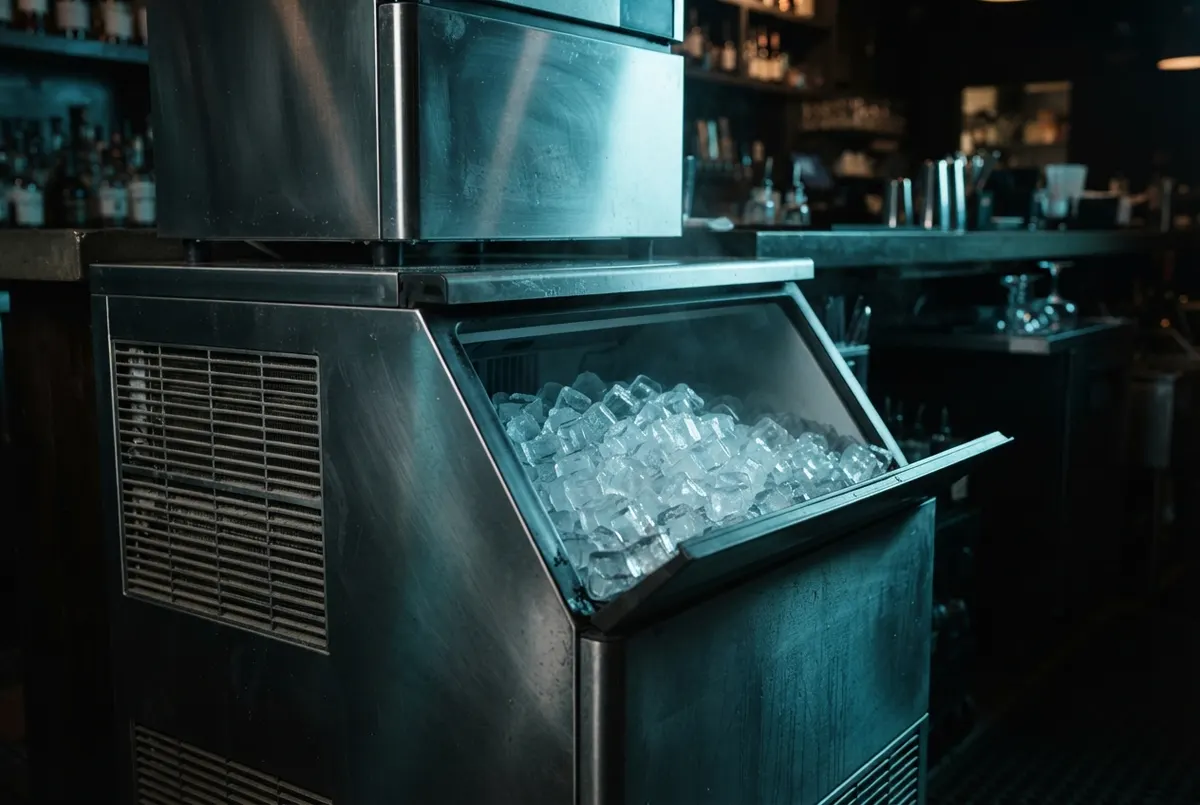
Commercial Ice Machine Repair
Thin cubes, cloudy ice, slow harvests and machines that have simply stopped.
Book a Service Call (678) 778-6648
- 20 yearsOwner’s time in the trade
- Snellville, GAGwinnett County and nearby
- Diagnosed firstMeasured before it is replaced
Pierre Refrigeration Services repairs commercial ice machines for restaurants, bars and convenience stores across Snellville and Gwinnett County. A machine making thin, cloudy or hollow cubes is nearly always telling you about water, not refrigeration — scale on the evaporator plate, a clogged water filter, or a failed water pump. Most units need a descale every six months to stay ahead of it.
What fails, and what it looks like
Your ice machine is a refrigeration system and a water system sharing one cabinet, and the water side causes most of the calls. The ice coming out of it usually tells you which side is at fault.
| Component | What you see |
|---|---|
| Evaporator plate scale | Cubes come out cloudy, undersized or hollow, and the harvest takes longer each week. |
| Water filter | Production falls off steadily over a month or two; the filter is past its date and nobody remembers changing it. |
| Water pump or distribution tube | Ice forms in patches across the plate instead of a full slab, or one section of the grid stays empty. |
| Water inlet valve or float | The machine cycles without filling, or overflows into the bin and freezes the ice into one block. |
| Condenser (air or water cooled) | Production drops in hot weather, the cabinet runs hot, and the machine cycles on high pressure. |
| Harvest assist or hot-gas valve | A full slab of good ice forms and then refuses to release, so the machine stalls mid-cycle. |
| Bin thermostat or level control | The bin sits half full and the machine will not restart, or it keeps running into a full bin. |
Symptoms on ice machines, and how long you have
Ice failures are gradual almost every time. Reading yours early is the difference between a descale and a rebuilt water circuit.
- Monitor it Cubes slightly smaller than they used to be
- Monitor it Harvest cycle noticeably slower than last season
- Call today Cubes coming out cloudy, hollow or misshapen
- Call today Machine running normally but the bin never fills
- Call today Ice tastes or smells of the room it sits in
- Call today Water overflowing into the bin and freezing the ice into a block
- Stop using it Visible pink or black slime inside the cabinet
- Stop using it Machine stalled mid-harvest with a full slab stuck on the plate
How a technician finds the fault
Your machine gets diagnosed by watching a whole cycle, not by reading a fault light. What it does at each stage narrows the cause to the water side or the refrigeration side before anything is taken apart.
-
Look at the ice itself
Thin, cloudy or hollow cubes point at water: scale, filtration or flow. Full-size clear cubes that arrive too slowly point at refrigeration or harvest instead.
-
Watch one complete cycle
Fill, freeze, harvest. Where the cycle slows or stalls localises the fault far faster than testing components in isolation.
-
Inspect the evaporator plate
Scale on the plate insulates it, so the machine spends longer making worse ice. On municipal water this is the single most common cause, and it builds on a schedule.
-
Check water supply, filter and pump
Inlet pressure, filter age and pump output all have to be right before the refrigeration side means anything. A starved plate cannot make a full slab no matter how cold it gets.
-
Check the condenser and the room
An air-cooled machine in a hot back corner loses production before anything has failed. The coil gets checked, and so does the air it is being asked to breathe.
-
Verify the harvest sequence
A machine that makes good ice and will not release it is failing at harvest — hot gas, the assist mechanism, or a curtain switch — not at freezing.
What moves the cost of the repair
Ice work splits cleanly into maintenance you are due for and repairs that follow from skipping it. Which side of that line you land on is mostly decided before the machine ever fails.
Pushes it up
- Descaling a machine that has gone years without one, where the deposit has to be broken down over several passes
- A water pump, inlet valve or distribution tube replaced after scale has already worn it
- Biofilm remediation, which is a full strip and sanitise rather than a cleaning cycle
- A sealed-system repair on the refrigeration side, which is the one part of an ice machine that gets expensive
- A machine built into your bar or into cabinetry, which has to be pulled before the head can be opened
Keeps it down
- Descaling and sanitising on schedule, typically twice a year on municipal water
- Changing the water filter on its date instead of when production drops
- Giving the condenser room to breathe and keeping its coil clean
- Calling while your ice is just getting small, rather than after the machine has stalled
You get the diagnosis and the number before any work starts — and a plain answer when the unit genuinely is not worth saving, rather than a replacement quote you have to go and get a second opinion on.
Questions operators actually ask
- Why is my ice machine making small or hollow cubes?
- Small, hollow or cloudy cubes almost always mean the water side is restricted. Scale on the evaporator plate, a filter past its life, or a weak water pump all starve the plate so the cube never finishes forming.
- How often does a commercial ice machine need cleaning?
- Descale and sanitise about every six months on municipal water, and more often on hard water or in a bar. That interval is what manufacturers set as a minimum, and most machines that fail early have been running well past it.
- Why has my ice machine stopped making ice completely?
- A machine that has stopped outright is usually stalled rather than broken. A full slab stuck on the plate, a tripped bin control, or a closed water supply will all halt production while the refrigeration side is perfectly healthy.
- Why does my ice taste bad?
- Ice picks up whatever is in the water and whatever is in the cabinet. An expired filter, biofilm in the water circuit, or a bin sitting near a fryer or a mop sink will all end up in the glass.
- Is descaling something staff can do?
- The routine cleaning cycle is a staff job on most machines and it is worth doing on schedule. A machine that has been neglected long enough to lose production usually needs the plate and the water circuit stripped, which is not.
- Why does production drop every summer?
- Air-cooled machines reject heat into the room they sit in, so a hot back corner in July costs real production. Before assuming a fault, check what the air around the condenser is doing and whether the coil is clean.
Related expertise
-
Ice machine not making ice
Working the cycle through, stage by stage.
-
Reach-in refrigerators
The other cabinet behind the bar, and how it fails.
-
Commercial refrigeration repair
Where ice machines sit inside the wider service.
-
Restaurants and foodservice
Bars and kitchens, where ice stops service before anything else does.
-
Convenience stores
Bagged and dispensed ice as a line of its own.
-
Ice machine maintenance: scale, sanitation and falling output
The descaling schedule this page keeps referring to, in full.